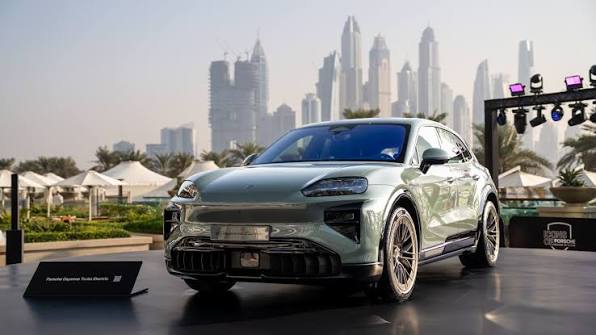
Porsche was once remarkably easy to describe.
It was a sports-car manufacturer.
The company’s reputation revolved around compact, focused vehicles built around performance and driving enjoyment.
Modern Porsche is much more complicated.
Today, a customer can purchase a traditional sports car, a luxury sedan, a family SUV or an electric performance vehicle while remaining within the same brand.
Rather than weakening Porsche’s identity, this expansion has made the company particularly well suited to places such as Dubai.
The city has an enormous appetite for performance cars, but it is also a place where buyers expect luxury, technology and everyday practicality.
Porsche has gradually learned how to combine all of those requirements.
The 911 Still Defines the Porsche Idea
No vehicle is more closely associated with Porsche than the 911.
Its basic silhouette has remained recognisable for generations, giving it an unusual level of continuity in an industry that frequently redesigns products completely.
Dubai’s automotive environment makes the 911 particularly interesting.
The city has no shortage of newer, more dramatic supercars.
Yet the Porsche does not have to depend on novelty to remain desirable.
Its appeal comes from decades of engineering development, motorsport history and an identity that customers recognise immediately.
A 911 can attract attention without needing to look radically different from the generations that came before it.
That kind of heritage is difficult for newer performance manufacturers to replicate.
The Cayenne Changed What Porsche Could Be
The arrival of the Cayenne represented one of the biggest changes in Porsche’s modern history.
The idea of a Porsche SUV initially seemed contradictory.
Sports cars were low, relatively compact and focused. SUVs were large, heavy and practical.
The Cayenne demonstrated that those categories did not have to remain completely separate.
Its commercial success also helped establish the performance SUV as a serious premium category.
Dubai is one of the places where the logic of that decision is particularly clear.
Customers often want one vehicle to provide luxury, passenger space, strong highway performance and an engaging driving experience.
A traditional two-door sports car cannot satisfy all of those requirements.
A performance SUV can.
The Macan Makes the Formula More Manageable
Not every Dubai customer wants a large SUV.
The Macan applies Porsche’s performance approach to a more compact package.
For urban use, that has obvious advantages.
The vehicle is easier to manoeuvre and park while still providing the elevated seating position and everyday practicality that make crossovers attractive.
This creates an interesting entry point into Porsche ownership.
A driver can choose a vehicle suitable for normal commuting and family duties without abandoning the brand’s performance identity.
The concept also demonstrates how much the definition of a sports-car manufacturer has changed.
A company can now communicate sporting character through vehicles that have five doors and useful luggage space.
The Panamera Gives Sedans a Porsche Interpretation
Porsche approached four-door luxury differently through the Panamera.
Instead of trying to create a conventional executive sedan, the company built a grand touring vehicle around its own performance philosophy.
This format works particularly well in Dubai.
Long, high-speed roads reward vehicles that can combine stability, comfort and effortless acceleration.
At the same time, four doors and proper rear seats make the Panamera considerably easier to integrate into everyday life than a traditional sports car.
For customers who prefer a lower driving position but still need passenger space, it provides an alternative to the SUV.
The Taycan Redefined Electric Porsche Performance
Electrification presented Porsche with a much bigger philosophical challenge.
Combustion engines had always played a major role in the emotional character of sports cars.
Electric vehicles remove much of that traditional experience.
However, electric motors bring performance advantages of their own.
They can deliver power almost instantly and provide exceptionally strong acceleration.
The battery can also be positioned low in the vehicle, helping create a lower centre of gravity.
The Taycan demonstrated Porsche’s attempt to translate its performance identity into this new environment.
The goal was not merely to build a fast electric car.
It was to build an electric vehicle that still felt connected to the characteristics customers expected from Porsche.
Dubai Is Becoming More Suitable for Performance EVs
The UAE is an interesting market for electric Porsche models.
Premium customers are more likely than average to have access to private parking and home charging.
That can transform the EV ownership experience.
Instead of treating charging as a separate weekly activity, an owner can connect the vehicle at home and begin normal daily journeys with a replenished battery.
Dubai’s growing charging network adds additional flexibility.
This does not mean every Porsche customer will immediately abandon combustion engines.
For many enthusiasts, traditional sports cars will retain strong emotional appeal.
The important point is that Porsche can now serve both groups.
Performance SUVs Have Become Normal
What once seemed controversial has now become mainstream.
Almost every major luxury-performance manufacturer offers an SUV.
Dubai roads make the popularity of these vehicles easy to understand.
A performance SUV can carry children to school in the morning, transport luggage in the afternoon and still provide acceleration that would once have belonged exclusively to dedicated sports cars.
For many customers, this eliminates the need to choose between practicality and enthusiasm.
Porsche was early in recognising how significant that market could become.
The Cayenne and Macan are therefore not side projects.
They are central to what the modern Porsche brand represents.
Everyday Usability Has Expanded the Porsche Audience
One of Porsche’s biggest achievements has been making its performance identity relevant to customers who could not realistically use a traditional sports car every day.
A household may only have space or budget for one premium vehicle.
If that vehicle has to carry passengers, shopping and luggage, a two-seat or small sports car may simply be impractical.
SUVs, four-door models and EVs allow Porsche to reach those customers.
This does not mean the sports car has become unimportant.
Instead, the rest of the range allows more people to participate in the Porsche brand without forcing their lifestyle to fit around the vehicle.
Specialised Maintenance Remains Essential
Porsches are sophisticated vehicles.
Performance powertrains, electronics, suspension systems and increasingly complex EV technology require knowledgeable servicing.
Dubai’s heat adds another challenge.
Correct maintenance is particularly important for cooling systems, tyres and batteries.
An established authorised dealer therefore plays an important role in the ownership experience.
Customers purchasing a premium performance vehicle expect technical expertise to remain available long after the original sale.
Why Porsche Works So Well in Dubai
Dubai represents almost the perfect environment for modern Porsche.
The city has strong demand for luxury and performance, excellent road infrastructure and customers willing to embrace new automotive technology.
At the same time, practical requirements remain important.
Porsche can now offer a 911 to the traditional sports-car enthusiast, a Cayenne or Macan to the family buyer, a Panamera to the grand-touring customer and an electric model to someone interested in the future of performance.
The vehicles are very different, but they share a central promise: practicality does not have to eliminate driving enjoyment.
That idea explains how Porsche evolved from a specialist sports-car company into a brand capable of fitting almost every part of Dubai’s premium automotive lifestyle.
Porsche is represented in Dubai and the Northern Emirates by Al Nabooda Automobiles.
Contributed by GuestPosts.biz.