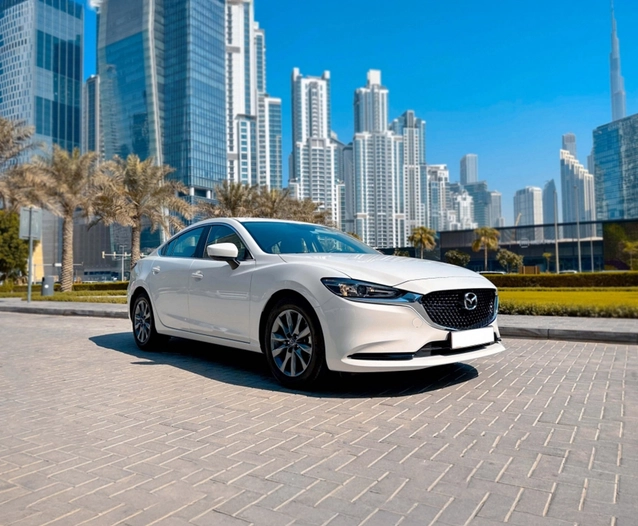
The modern automobile industry is increasingly dominated by technology.
Every new generation seems to bring larger screens, additional cameras, more software and increasingly sophisticated driver-assistance systems.
These developments can make vehicles safer and more convenient, but they also raise an interesting question.
Does the way a car actually feels to drive still matter?
Mazda has built much of its identity around the belief that it does.
The Japanese manufacturer is not one of the world’s largest automakers, and it does not attempt to compete by producing a vehicle for every possible market niche.
Instead, Mazda has traditionally focused on design, efficient engineering and creating a stronger connection between the driver and the car.
That philosophy gives the company an interesting position in Dubai’s increasingly crowded automotive market.
A Different Approach to Mainstream Cars
Mainstream vehicles are often designed to appeal to the widest possible audience.
That approach makes commercial sense.
However, it can also result in cars that begin to feel remarkably similar.
Comparable body shapes, large central screens and similar equipment lists are now common across many manufacturers.
Mazda has tried to maintain a more distinctive character.
Its vehicles tend to emphasise clean design, carefully considered interiors and controls intended to feel natural rather than unnecessarily complicated.
For Dubai motorists comparing a large number of Japanese, Korean, European and Chinese alternatives, this difference can matter.
A vehicle does not have to be the most powerful or expensive option in its category to feel special.
Sometimes the details experienced every day can be more important.
The Mazda3 Shows Why Smaller Cars Still Matter
SUVs dominate much of the automotive conversation, but compact cars continue to have genuine advantages.
The Mazda3 is a good example.
Its smaller dimensions make it easier to manoeuvre through crowded parts of the city and simpler to park in apartment buildings, shopping centres and commercial districts.
Dubai may have wide highways, but drivers do not spend every minute on Sheikh Zayed Road.
Basement parking areas, older neighbourhoods and busy urban streets can make a more manageable vehicle extremely convenient.
The Mazda3 also demonstrates that practical transportation does not have to feel purely functional.
Its design and driver-focused character give customers something beyond simply travelling from one destination to another.
For professionals, couples and smaller households, that combination can remain highly attractive.
Sedans Still Have a Role in the UAE
The popularity of SUVs sometimes creates the impression that traditional sedans are disappearing completely.
That is not the case.
Mazda continues to offer sedan choices in the UAE, including the Mazda3 and Mazda6.
For motorists who do not need substantial ground clearance or three rows of seating, a sedan can still provide an excellent balance between comfort, efficiency and road manners.
Dubai’s extensive highway network also works particularly well with this format.
A well-designed sedan can remain stable and comfortable during longer journeys while generally being lighter and more aerodynamic than a comparable SUV.
For drivers regularly travelling between Dubai and other Emirates, those characteristics can still be valuable.
Crossovers Have Become Essential to Mazda
Mazda has nevertheless responded strongly to the global shift toward crossovers and SUVs.
Its current UAE range includes models such as the CX-3, CX-30, CX-5, CX-60 and CX-90.
That progression allows customers to choose very different levels of passenger space and practicality without leaving the brand.
A compact crossover can work well for a single professional or couple.
A growing family may prefer something such as the CX-5, while customers requiring substantially more space can move toward larger models such as the CX-90.
This breadth has become essential in Dubai.
The city’s households vary enormously, and there is no single SUV size capable of satisfying everyone.
The CX-5 Occupies an Important Middle Ground
The CX-5 sits in one of the most competitive parts of the automobile market.
Vehicles of this size have become popular because they provide much of the usefulness associated with an SUV without becoming unnecessarily large.
For Dubai residents, that balance works particularly well.
A vehicle needs to carry shopping, luggage and family members while remaining convenient enough for everyday commuting and parking.
The CX-5 format allows drivers to gain an elevated seating position and flexible cargo space without moving into full-size SUV dimensions.
This makes it suitable for the type of mixed use common throughout Dubai.
The same car can handle school journeys, office commuting, shopping and longer weekend travel.
Mazda Is Moving Further Upmarket
Models such as the CX-60 and CX-90 demonstrate another important development.
Mazda is increasingly attempting to provide more sophisticated interiors and larger vehicles without becoming a traditional luxury brand.
This is an interesting strategy.
The difference between mainstream and premium automobiles has become less obvious in recent years.
Vehicles from non-luxury manufacturers can now include high-quality materials, advanced technology and extensive comfort equipment that would once have been associated almost exclusively with expensive European brands.
For Dubai customers, this creates more choice.
A buyer may want a refined and well-equipped SUV without placing major importance on owning a traditional luxury badge.
Mazda can potentially appeal to that group.
The MX-5 Preserves a Simpler Philosophy
One model remains particularly important to Mazda’s identity: the MX-5.
Dubai is filled with extremely powerful cars.
Against that background, a lightweight two-seat roadster can almost seem unusual.
The MX-5 follows a different philosophy.
Rather than relying on enormous horsepower, it focuses on relatively low weight, compact dimensions and driver involvement.
It suggests that enjoyment does not necessarily require the fastest possible acceleration.
A responsive car can be entertaining because of how it communicates with the driver rather than simply because of the numbers on a specification sheet.
That makes the MX-5 important even to customers purchasing other Mazda models.
It demonstrates that the company still considers driving itself part of the product.
Simple Controls Can Be a Modern Advantage
Automotive technology is improving rapidly, but additional complexity is not always better.
Touchscreens can perform an extraordinary number of functions, yet requiring a driver to navigate multiple menus for simple adjustments can become frustrating.
The best technology should reduce effort rather than create it.
Mazda has often placed emphasis on keeping the relationship between driver and controls relatively straightforward.
That philosophy may become increasingly valuable as vehicles become more digital.
Good design is not simply about adding the largest possible display.
It is also about deciding what the driver should be able to operate quickly and intuitively.
For someone spending hours each week in Dubai traffic, ease of use matters.
Design Is Another Important Part of the Experience
Mazda’s exterior styling also helps differentiate the brand.
Rather than relying heavily on exaggerated shapes and decorative elements, many Mazda vehicles use cleaner surfaces and relatively restrained proportions.
That can appeal to buyers who want something distinctive without becoming overly dramatic.
Dubai has no shortage of vehicles designed to attract maximum attention.
There is also a market for design that feels sophisticated in a quieter way.
A car may need to look appropriate outside an office building during the week while remaining practical enough for normal family life.
Mazda’s approach fits that requirement well.
The UAE Climate Makes Servicing Important
No matter how enjoyable a car is to drive, ownership also depends on maintenance.
Dubai’s climate places substantial demands on vehicles.
High temperatures affect batteries, tyres, air conditioning and cooling systems.
Regular servicing therefore remains essential.
An established local dealer network gives owners access to trained technicians, genuine parts and support throughout the life of the vehicle.
Mazda has been represented in the UAE by Galadari Automobiles for more than four decades, with showrooms and service facilities across Dubai and the other Emirates.
That long local presence gives customers confidence that support will remain available after the initial purchase.
Why Mazda Still Has Something Different to Offer
The automobile industry is moving rapidly toward electrification, automation and software.
Those technologies will continue transforming the way people use cars.
Yet vehicles remain physical machines that drivers interact with every day.
Steering, visibility, seating position, comfort and the way controls respond continue to shape the ownership experience.
Mazda’s opportunity is to preserve attention to those qualities while adopting the technologies customers increasingly expect.
Dubai motorists have access to almost every major global manufacturer, which makes differentiation increasingly difficult.
Mazda does not necessarily need to become the largest brand in the market.
Its advantage is having a recognisable philosophy.
For motorists who still care about how an everyday vehicle feels rather than judging it only by screen size or equipment lists, that philosophy continues to offer something worthwhile.
Mazda is represented in the UAE by Galadari Automobiles.
Contributed by GuestPosts.biz.