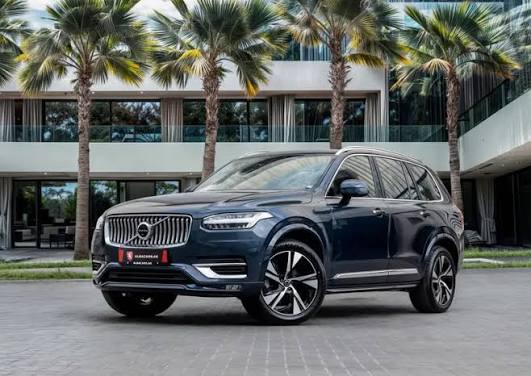
Volvo occupies a distinctive position in Dubai’s premium automobile market.
The Swedish manufacturer does not build its identity primarily around aggressive performance, dramatic styling or traditional luxury status.
Instead, Volvo has spent decades creating a reputation around safety, restrained Scandinavian design and vehicles intended to make everyday driving feel calm and secure.
That approach can work particularly well in Dubai.
The city has no shortage of powerful and expensive cars, but most residents still spend the majority of their driving time commuting, transporting family members, travelling between Emirates and dealing with ordinary traffic.
In those situations, comfort, safety and ease of use can matter much more than extreme performance.
Volvo’s current UAE range increasingly combines those traditional strengths with electric and hybrid technology.
Safety Remains Central to the Volvo Identity
Few automotive manufacturers are as strongly associated with safety as Volvo.
That reputation has become one of the company’s most valuable assets.
Modern vehicles across the industry now include sophisticated safety systems, but Volvo has treated the subject as a core part of its engineering philosophy for generations.
For Dubai families, that matters.
Highway speeds can be significant, traffic density varies dramatically and long journeys are common.
A vehicle designed around protecting occupants and assisting the driver therefore offers benefits that can be appreciated every day.
Safety may not create the same excitement as horsepower figures, but it can become far more important during actual ownership.
Driver-Assistance Technology Has Changed the Safety Conversation
Automotive safety once focused primarily on what happened during a collision.
Modern vehicles increasingly attempt to prevent the collision from occurring in the first place.
Cameras, sensors and driver-assistance systems can help monitor surrounding traffic, lane position and potential hazards.
These technologies are particularly relevant to Dubai’s multilane highway environment.
Drivers may spend long periods travelling at relatively high speeds while traffic conditions change around them.
Systems designed to provide warnings or assistance can reduce some of the pressure associated with these journeys.
They cannot replace an attentive driver, but they can provide an additional layer of support.
The XC90 Remains an Important Family SUV
The XC90 is one of Volvo’s most recognisable premium SUVs.
Its size makes it particularly relevant to Dubai families.
Three-row seating can provide flexibility when children, relatives or visitors need to travel together.
Airport journeys also become easier when passenger and luggage requirements increase.
However, the XC90 approaches the large-SUV category differently from many competitors.
Its design is relatively restrained.
The cabin focuses more heavily on calm materials and Scandinavian simplicity than visual excess.
For buyers who want substantial family space without an aggressive luxury-SUV personality, this can be appealing.
The XC60 Finds the Middle Ground
Not every family needs a vehicle as large as the XC90.
The XC60 provides a more manageable alternative.
This may actually make it better suited to many Dubai households.
It offers SUV practicality while remaining easier to manoeuvre through residential garages, shopping centres and dense commercial districts.
The midsize premium SUV category has become enormously competitive precisely because it fits so many lifestyles.
A vehicle can handle family responsibilities without becoming unnecessarily large.
For couples or smaller households, the XC60 may provide all the space required while still delivering the elevated driving position customers increasingly prefer.
The XC40 Offers a More Urban Volvo
The XC40 moves the same philosophy into a smaller package.
Compact premium SUVs have become important because cities are becoming denser even as customers continue to prefer crossover styling.
Dubai is expanding rapidly, but urban ownership still involves parking constraints and crowded destinations.
A smaller SUV can make daily life easier.
The XC40 demonstrates that choosing a premium vehicle does not automatically require choosing a large one.
For professionals whose routine consists mainly of commuting, shopping and urban journeys, compact dimensions may actually provide the more luxurious experience because they reduce inconvenience.
The EX30 Shows How Volvo Is Rethinking the Entry-Level EV
Volvo’s electric strategy introduces an even more interesting option.
The EX30 is significantly more compact than traditional premium SUVs.
Its role is important because electric vehicles do not need to become increasingly large simply to feel sophisticated.
For urban Dubai residents, a compact EV can make considerable sense.
Daily journeys may be predictable.
Home or workplace charging can handle much of the vehicle’s energy requirement.
Smaller dimensions make parking easier.
Electric motors provide smooth and responsive acceleration.
The combination creates a vehicle designed specifically for modern city use.
The EX90 Brings Electrification to the Large Family SUV
At the opposite end of the spectrum sits the EX90.
The model applies Volvo’s electric strategy to a large premium SUV format.
This could become particularly relevant in the UAE.
Many families want three-row practicality but increasingly also want to consider electric mobility.
Historically, these two requirements limited the available choices.
Large electric SUVs are changing that.
An electric three-row vehicle can provide the passenger space expected from a traditional family SUV while replacing the combustion engine with a quieter electric powertrain.
For households with private charging, this can become a realistic alternative rather than simply an experimental product.
Electric Power Naturally Fits Volvo’s Calm Character
Some brands need to reinvent their personalities when moving to electric vehicles.
Volvo faces less of a conflict.
The company has traditionally emphasised refinement, safety and relaxed driving rather than engine sound or mechanical drama.
Electric power reinforces many of those values.
The motors operate quietly.
Acceleration can be delivered smoothly.
The cabin can become even more peaceful without a combustion engine operating underneath it.
This allows Volvo to modernise the technology without completely redefining what customers already expect from the brand.
The ES90 Extends the Electric Strategy Beyond SUVs
The increasing popularity of SUVs does not mean every premium customer wants one.
Volvo’s electric portfolio also includes the ES90, providing another approach to long-distance premium travel.
A lower-bodied electric car can offer aerodynamic advantages and a different road experience from a large crossover.
Dubai’s highways suit this type of vehicle well.
Drivers travelling frequently between business districts or Emirates may appreciate a quieter, lower and more streamlined car.
The broader lesson is that electrification does not require every vehicle to adopt exactly the same shape.
Plug-In Hybrids Offer a Transitional Option
Not every customer is ready to move directly into a fully electric vehicle.
Charging availability, home circumstances and travel patterns differ.
Plug-in hybrids therefore continue to provide an alternative.
Models such as Volvo’s XC60 and XC90 plug-in hybrids allow drivers to complete some journeys electrically while retaining a combustion engine for longer trips.
For Dubai customers uncertain about committing fully to charging infrastructure, this flexibility can be reassuring.
The vehicle can adapt to both environments.
Scandinavian Design Offers a Different Kind of Luxury
Volvo’s interior philosophy is also significant.
Traditional automotive luxury often relies on visual complexity.
Large amounts of decorative trim, dramatic lighting and elaborate shapes are used to communicate expense.
Scandinavian design tends to approach luxury differently.
Clean surfaces, natural-looking materials and restrained layouts create a calmer environment.
For some Dubai buyers, this can feel more sophisticated than a cabin attempting to attract attention everywhere.
Luxury does not always need to be loud.
Sometimes the ability to reduce visual stress can itself feel premium.
Dubai’s Climate Makes Cabin Comfort Especially Important
Interior comfort has particular importance in the UAE.
During summer, drivers may enter vehicles that have been parked under intense sunlight.
Air conditioning needs to cool the cabin quickly and remain effective throughout the journey.
Seat comfort, ventilation and climate-control performance therefore influence daily ownership significantly.
Premium vehicles need to succeed under these conditions rather than simply perform well in mild European climates.
This makes strong local dealer support essential.
Trading Enterprises Provides Volvo’s UAE Infrastructure
Volvo Cars is represented in the UAE through Trading Enterprises, part of Al-Futtaim Automotive.
The company’s official UAE system identifies Trading Enterprises as the selected importer, giving customers access to local sales and aftersales support.
This established infrastructure matters as Volvo’s technology becomes increasingly diverse.
A dealership now needs to understand conventional powertrains, plug-in hybrids and fully electric vehicles.
Technical expertise therefore becomes a significant part of the ownership experience.
Why Volvo Has a Clear Place in Dubai
Volvo offers something different from many premium competitors.
It does not need to be the most aggressive luxury brand on Sheikh Zayed Road.
Its strengths are safety, restrained design, family practicality and an increasingly broad electrified range.
The XC40 and XC60 provide manageable SUV options.
The XC90 serves larger households.
The EX30 demonstrates the appeal of compact electric mobility, while the EX90 brings EV technology into the three-row premium-SUV market.
For Dubai customers who define luxury through comfort, security and intelligent design rather than maximum visual drama, Volvo provides a compelling alternative.
Volvo is represented in the UAE by Trading Enterprises, part of Al-Futtaim Automotive.
Contributed by GuestPosts.biz.