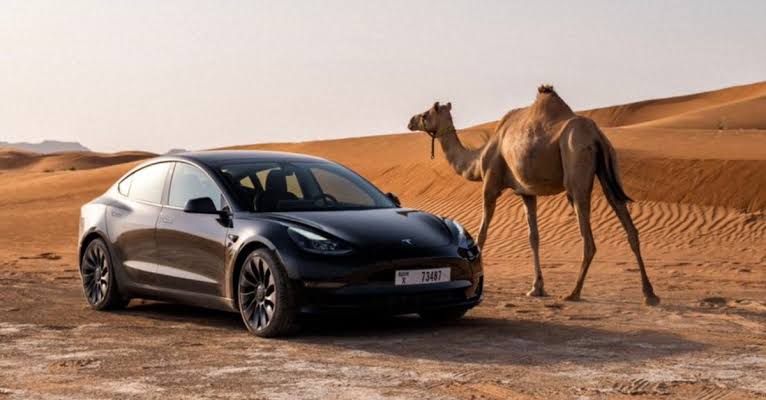
Very few automobile manufacturers have changed public expectations as quickly as Tesla.
Before the company’s rise, electric cars were often viewed as specialised products.
They were associated with short range, unusual styling or environmental enthusiasm rather than mainstream desirability.
Tesla helped change that perception.
It demonstrated that electric cars could offer long range, rapid acceleration, sophisticated software and a completely different ownership experience.
Today, almost every major manufacturer has an electric strategy.
That alone shows how much the market has changed.
In the UAE, Tesla now faces a new challenge.
It is no longer the unusual electric alternative.
It competes in an increasingly crowded EV market filled with established luxury manufacturers and ambitious new brands from China, Europe and elsewhere.
The question is no longer whether electric cars can work in Dubai.
It is what makes Tesla different now that everyone else has joined the race.
Tesla Changed the Car Into a Software Platform
One of Tesla’s most important contributions was redefining the relationship between software and the automobile.
Traditional cars were largely finished products at the moment of purchase.
Software-controlled vehicles can continue evolving.
Over-the-air updates allow manufacturers to change interfaces, improve systems and add functionality without requiring the owner to visit a workshop for every modification.
This approach has now spread throughout the industry.
But Tesla helped establish the idea that a car could behave more like a connected technology product.
For Dubai customers accustomed to smartphones, apps and digital services, this model feels increasingly natural.
The Model 3 Remains the Accessible Performance Sedan
The Model 3 continues to play a major role in Tesla’s UAE lineup.
Its basic concept is straightforward.
Provide the range and technology associated with a premium EV in a relatively manageable sedan.
Current UAE configurations offer several different interpretations, from rear-wheel-drive efficiency to high-performance dual-motor versions.
That flexibility is important.
Not every EV buyer has the same priorities.
One customer may care primarily about maximum range.
Another may want all-wheel drive.
An enthusiast may be more interested in the Model 3 Performance.
Tesla can address all three without creating completely separate vehicles.
Long Range Makes Everyday EV Ownership Easier
One of the strongest arguments for modern electric vehicles is that range has improved dramatically.
Current Model 3 configurations sold in the UAE provide figures far beyond what early mass-market EVs could achieve.
For many Dubai residents, this means charging does not need to happen every day.
A typical commute may consume only a fraction of the available battery.
For owners with home charging, the process becomes even simpler.
The car charges while parked.
The customer starts the next journey without making a dedicated stop for fuel.
This is one of the aspects of electric ownership that can be difficult to appreciate until someone experiences it.
The Model Y Is Arguably Even More Important
Globally, customer preferences have shifted strongly toward SUVs and crossovers.
That makes the Model Y strategically essential.
The vehicle provides the higher seating position and additional practicality many families prefer while retaining Tesla’s electric architecture and digital environment.
The updated Model Y has also received substantial changes aimed at improving refinement.
Tesla says the redesign reduces road, impact and wind noise while improving comfort and efficiency.
These changes matter because the EV market is becoming more mature.
Rapid acceleration alone is no longer enough.
Customers expect ride quality, cabin refinement and build quality to compete with increasingly strong rivals.
Efficiency Can Be More Important Than Battery Size
Tesla has traditionally focused heavily on vehicle efficiency.
This matters because adding a larger battery is not the only way to increase range.
If a car uses less energy per kilometre, the same battery can travel farther.
Lower consumption can also reduce charging time because the vehicle needs less energy for the same journey.
This is one of the less dramatic but more important parts of EV engineering.
Dubai’s high temperatures can increase energy use because air conditioning works heavily.
Efficient vehicle design therefore has real practical value.
The Supercharger Network Remains a Major Part of the Experience
Charging infrastructure has always been central to Tesla’s strategy.
A good EV is significantly less useful if long-distance charging is unreliable or difficult to access.
Tesla’s Supercharger network helps connect the vehicle with the infrastructure required to use it.
The UAE’s broader charging ecosystem has also expanded substantially.
For customers, this reduces one of the biggest historical obstacles to EV ownership.
Charging still requires more planning than filling a petrol tank during some journeys.
However, the gap is narrowing.
As charging speeds and infrastructure improve, the experience becomes progressively easier.
Tesla’s Minimalist Cabin Changed Interior Design
The Model 3 helped popularise another controversial idea: move most vehicle functions onto a central touchscreen.
Many manufacturers subsequently moved in the same direction.
The advantages are clear.
A digital interface can be updated and redesigned through software.
Physical dashboards can become visually cleaner.
However, touchscreen-heavy interiors also generate debate.
Some drivers prefer physical buttons for frequently used functions because they can be operated without looking away from the road.
Tesla represents one extreme of this design philosophy.
Whether customers love or dislike it, its influence on the industry is undeniable.
Performance Has Become Almost Effortless
Electric motors have transformed expectations around acceleration.
The Model 3 Performance illustrates this clearly.
The current UAE version can accelerate from 0 to 100 km/h in approximately 3.1 seconds.
Not long ago, that level of performance was associated with exotic sports cars.
Now it can exist in a four-door electric sedan capable of handling ordinary commuting.
This has forced the entire performance-car industry to respond.
Horsepower and acceleration alone are no longer exclusive.
Traditional performance brands increasingly need to emphasise handling, sound, craftsmanship and emotional character to justify their position.
Driver Assistance Needs Accurate Expectations
Tesla’s driver-assistance technology is one of the most discussed aspects of the brand.
It is also an area where clear expectations are essential.
Tesla’s UAE website currently states that Full Self-Driving (Supervised) is not available in the United Arab Emirates.
Available driver-assistance features still require active driver supervision and do not make the vehicle autonomous.
This distinction matters.
Advanced assistance can make some driving situations easier, but drivers remain responsible for operating the vehicle safely.
The terminology surrounding automated driving can easily create unrealistic expectations if these limitations are ignored.
Direct Sales Make Tesla Different From Traditional Brands
Tesla also changed the traditional dealership model.
In the UAE, the company sells and supports vehicles directly rather than appointing a conventional independent distributor.
Tesla operates its own locations, including Tesla Centre Dubai on Sheikh Zayed Road and a retail store at City Centre Mirdif.
Customers can order vehicles through Tesla’s digital platform and interact directly with the manufacturer.
This creates a different relationship.
The company controls pricing, software, sales and service more closely than manufacturers working through independent dealer groups.
Service Is Also Becoming More Digital
Tesla’s approach to maintenance differs from conventional combustion vehicles.
Electric motors have fewer routine mechanical service requirements than petrol engines.
There are no oil changes in the traditional sense, and many diagnostic functions can be handled digitally.
Tesla also offers remote diagnostics and mobile service for certain issues.
This can reduce the need for conventional workshop visits.
However, electric vehicles still require maintenance.
Tyres, suspension, air conditioning, brakes and other components remain important.
Dubai’s climate makes some of these systems particularly demanding.
Extreme Heat Is One of the UAE’s Biggest EV Tests
Summer conditions provide a serious test for every electric vehicle.
Battery packs need active thermal management.
Cabins require substantial cooling.
Vehicles parked outdoors can become extremely hot.
Tesla has considerable experience operating EVs in warm climates, but owners still need to understand that environmental conditions affect range and efficiency.
Real-world consumption can differ from ideal laboratory figures.
This applies to every EV manufacturer.
The most useful question is not whether heat affects an electric vehicle.
It is how effectively the vehicle manages that heat.
Competition Is Much Stronger Than It Used to Be
Tesla’s position in the UAE is very different from several years ago.
BYD, Polestar, ZEEKR, Lucid and numerous established manufacturers now offer compelling electric alternatives.
Some compete through design.
Others emphasise luxury, ultra-fast charging, advanced battery technology or aggressive pricing.
This creates pressure on Tesla.
The company can no longer rely simply on being the obvious EV choice.
It has to continue improving quality, efficiency, software and the ownership experience.
For buyers, this competition is beneficial.
Tesla’s Influence Goes Beyond Its Own Sales
Even motorists who never purchase a Tesla have been affected by the company.
Electric range expectations increased.
Large touchscreens became more common.
Over-the-air updates spread across the industry.
Performance EVs became mainstream.
Direct-to-consumer automotive retail gained credibility.
Charging networks became a strategic priority.
Tesla helped accelerate all of these changes.
Its long-term importance therefore cannot be measured only by how many Model 3s or Model Ys appear on Dubai roads.
Why Tesla Still Matters in the UAE
Tesla now operates in a much more competitive environment, but many of its original strengths remain relevant.
The Model 3 combines range, performance and a relatively compact footprint.
The Model Y provides the crossover practicality that many UAE families prefer.
The Supercharger ecosystem and software integration support everyday electric ownership.
Direct sales create a distinctive retail model.
Tesla’s challenge is no longer proving that EVs can work.
The company helped settle that question.
Its next challenge is staying ahead now that nearly every major automotive manufacturer is pursuing the same future.
Tesla sells and supports its vehicles directly in Dubai through Tesla UAE and Tesla Centre Dubai.
Contributed by GuestPosts.biz.