Not every important vehicle in Dubai is parked outside a luxury hotel.
Some are delivering food.
Others are carrying construction materials, tools, equipment or refrigerated products.
Many spend almost the entire working day on the road.
These vehicles rarely receive the same attention as supercars or luxury SUVs, but they are essential to how the city functions.
This is the world where Isuzu has built much of its reputation.
The Japanese manufacturer has long specialised in pickups and commercial trucks, focusing heavily on durability, operating efficiency and vehicles designed to work rather than simply impress.
In the UAE, that philosophy remains highly relevant.
Commercial Vehicles Are Business Assets
A private car can be inconvenient when it breaks down.
A commercial vehicle can cost a company money every hour it remains unavailable.
This distinction changes the purchase decision completely.
Fleet operators care about reliability, servicing, fuel consumption and parts availability because all of them affect profitability.
A truck is not simply transportation.
It may be the tool that allows a business to function.
This is why commercial vehicle buyers often remain loyal to manufacturers with long histories in the sector.
Isuzu has built its name around exactly this type of customer.
The N-Series Is Built Around Urban Work
Isuzu’s N-Series is one of the most recognisable light-duty truck families in commercial transportation.
Its cab-over design places the cabin above the engine area, allowing a relatively compact overall footprint while preserving useful cargo-body length.
This format works particularly well in urban environments.
Dubai businesses may need to navigate industrial areas, commercial districts and busy city streets before reaching customers.
A truck that is unnecessarily large can become difficult to manoeuvre.
The N-Series attempts to balance payload capability with city usability.
One Truck Platform Can Perform Many Jobs
Commercial trucks are rarely sold as one fixed product.
The chassis may become a refrigerated vehicle, box truck, recovery truck, tanker or numerous other specialised configurations.
This flexibility is extremely important.
A restaurant supplier has different requirements from a construction company.
A logistics operator may need a completely enclosed body.
A recovery company needs specialised equipment.
Isuzu’s commercial platforms can be adapted to these different roles.
This allows one truck family to support many sectors of the UAE economy.
Dubai’s Logistics Economy Creates Natural Demand
Dubai’s growth has created enormous demand for commercial transportation.
Retailers need products delivered.
Hotels require constant supplies.
Construction projects need equipment and materials.
E-commerce has expanded last-mile logistics.
Maintenance companies move technicians and tools around the city every day.
None of these activities receive the same public attention as passenger-car launches, yet together they create a huge vehicle market.
Brands with strong commercial expertise benefit directly.
Isuzu’s presence in this sector gives it relevance beyond ordinary consumer automotive trends.
The F-Series Moves Into Heavier Work
The F-Series serves customers requiring greater capacity.
Heavier commercial vehicles need to operate under significantly higher loads and may spend much of their working lives carrying cargo.
Reliability becomes especially important.
Mechanical downtime affects not only the cost of repairing the truck but potentially the goods, employees and schedules connected to it.
For companies operating multiple vehicles, even small differences in availability can become significant across the fleet.
This is why commercial buyers often examine total operating cost rather than simply purchase price.
Total Cost of Ownership Matters More Than the Sticker Price
A cheaper truck is not necessarily the cheaper truck to own.
Commercial operators calculate fuel consumption, maintenance intervals, tyre use, parts pricing, resale value and vehicle availability.
These expenses accumulate across hundreds of thousands of kilometres.
A vehicle that costs slightly more initially may be economically preferable if it operates reliably and retains greater residual value.
Manufacturers with established commercial reputations therefore have an advantage.
Business customers often make decisions using spreadsheets rather than emotion.
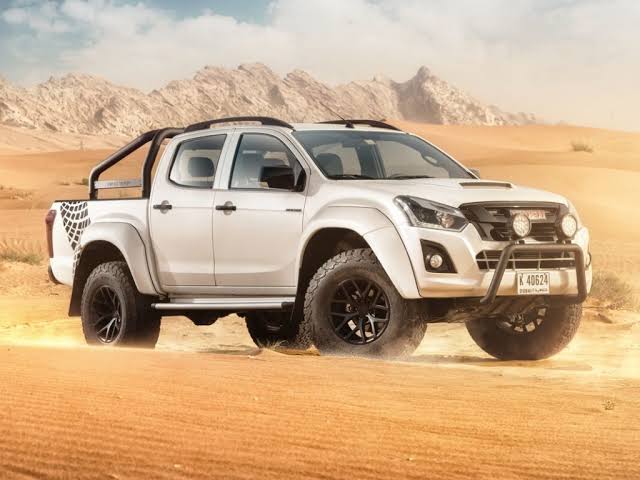
The D-MAX Brings Isuzu Expertise Into Pickup Form
The D-MAX gives Isuzu a product that sits between commercial and private use.
Pickups have changed dramatically.
They remain important working vehicles, but many customers also use them for outdoor activities and personal transportation.
This is particularly relevant in the UAE.
A pickup can carry tools during the week and camping equipment during the weekend.
Its open bed handles loads that would be difficult or undesirable to carry inside an SUV.
The D-MAX addresses exactly this mixed-use environment.
Pickups Fit the UAE Lifestyle Naturally
The UAE provides several reasons for pickup ownership.
Businesses need work vehicles.
Outdoor enthusiasts appreciate cargo flexibility.
Camping and desert activities create demand for vehicles capable of carrying equipment.
Wide highways also make pickups easier to live with than in many densely populated European cities.
A double-cab model can even perform family duties while retaining a separate cargo area.
This versatility explains why pickups increasingly appeal to customers outside traditional commercial sectors.
Durability Matters in Extreme Heat
Commercial vehicles in the UAE operate under difficult conditions.
Summer heat affects cooling systems, batteries, tyres and air conditioning.
Many trucks also spend long hours running continuously.
Heavy loads increase mechanical stress further.
This makes preventive maintenance extremely important.
A truck designed for commercial use needs to tolerate conditions that would be unusual for many private cars.
The regional ownership environment therefore rewards manufacturers with proven heavy-duty engineering.
Drivers Matter Too
Commercial vehicle design is increasingly focusing on the person behind the wheel.
A driver may spend eight, ten or more hours inside the vehicle.
Seat design, visibility, air conditioning and cabin ergonomics can directly affect fatigue.
This matters for both employee well-being and road safety.
A truck cannot be judged only by payload.
The working environment inside the cabin also influences productivity.
Modern commercial vehicles therefore need to balance durability with comfort much more effectively than older trucks did.
Downtime Makes Aftersales Support Critical
Commercial customers often choose a brand partly because of the service network behind it.
If a truck needs a part, waiting several weeks can be extremely expensive.
An authorised distributor needs to maintain workshop capacity and parts inventories capable of supporting fleet customers.
This is one of the reasons long-established dealer relationships are important in commercial transportation.
The vehicle and the support infrastructure effectively become one product.
GENAVCO Provides Isuzu’s Local Network
Isuzu is represented in the UAE through General Navigation and Commerce Company, better known as GENAVCO.
The company operates Isuzu sales and aftersales facilities in several Emirates.
In Dubai, Isuzu sales are located in Umm Ramool, while parts and service operations are available in Al Quoz.
The network also extends to Sharjah, Abu Dhabi and Al Ain.
For fleet operators, this coverage is valuable because commercial vehicles may work across the country rather than remaining in one city.
Commercial Expertise Is Difficult to Build Quickly
The rapidly changing passenger-car market has allowed many new manufacturers to establish themselves in only a few years.
Commercial vehicles present a different challenge.
Businesses want evidence that trucks can perform consistently over long periods.
A flashy launch cannot substitute for years of operation.
Isuzu benefits from a global reputation built around working vehicles.
This heritage is particularly valuable when customers are purchasing fleets rather than one individual truck.
The EV Transition Will Eventually Reach Commercial Transport
Electrification is beginning to affect trucks and commercial fleets as well.
Urban delivery vehicles can be strong candidates for electric power because routes are often predictable and vehicles return to a depot where charging can be installed.
However, heavy-duty applications remain more challenging.
Payload, charging time and long-distance operation create additional considerations.
Manufacturers specialising in commercial transport will have to balance these new technologies with the reliability businesses expect.
The transition may happen at different speeds across different vehicle categories.
Diesel Still Has Practical Advantages for Many Fleets
For many UAE operators today, traditional diesel trucks remain the most straightforward solution.
Fuel infrastructure is widespread.
Refuelling is fast.
Vehicles can cover long distances and carry heavy loads without charging downtime.
This does not mean commercial transport will remain unchanged indefinitely.
It simply shows that business customers evaluate technology according to operational needs rather than fashion.
Any new powertrain has to demonstrate that it improves the economics of the operation.
Why Isuzu Still Matters
Isuzu rarely generates the excitement of a new supercar.
Its vehicles serve a different purpose.
The N-Series handles countless light-commercial applications.
The F-Series supports heavier operations.
The D-MAX bridges the gap between working pickup and lifestyle vehicle.
Together, they contribute to the less visible transportation network that keeps the UAE economy moving.
For a business, the best vehicle may not be the one attracting the most attention.
It may be the one that starts every morning, performs its job and returns ready to do it again tomorrow.
Isuzu is represented in the UAE by GENAVCO.
Contributed by GuestPosts.biz.